
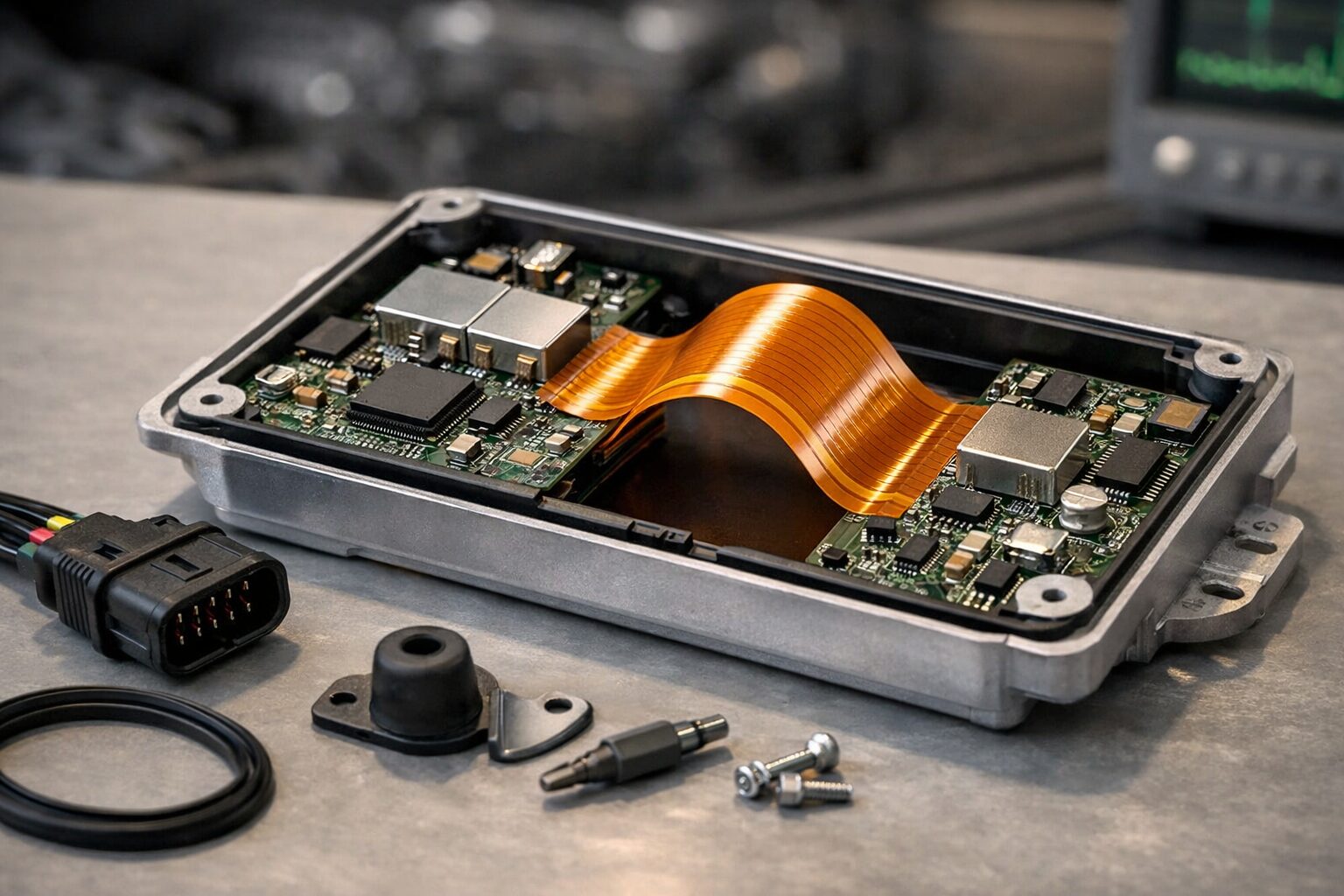
Car design today is like a rolling computer network. Modern automotive electronics must survive heat, vibration, moisture, and constant thermal cycling. PCBs support engine control systems, battery management, and driver-assist systems (ADAS). This is why the automotive rigid flex pcb solution has become a favorite for design engineers who want reliability without bulky wiring and connector-heavy assemblies.
I have years of experience with automotive and industrial PCB assemblies, and the same lesson comes up again and again: when systems fail in the field, it is rarely the chip doing the “fancy” work. Failures often start at stress points, connectors that loosen, cables that fatigue, or solder joints that crack after thousands of temperature changes. One direct way to reduce those weak links is rigid-flex design, without making the package larger or harder to maintain.
What a Rigid-Flex PCB Really Is in Automotive
An automotive rigid-flex PCB is an integrated circuit board that combines rigid board sections (FR-4 or similar) with flexible polyimide circuits. Instead of using separate boards connected by cables or mezzanine connectors, the flexible section becomes the built-in interconnect.
This approach:
- Reduces parts
- Simplifies assembly
- Often improves signal integrity
Why This Matters in Harsh Vehicle Environments
Automotive electronics operate in tough conditions.
Under-hood modules face high temperatures and rapid heat changes. Body and cabin modules experience vibration, humidity, and long service-life demands. When you eliminate extra connectors and harness segments, you remove common failure points.
Why Automotive Electronics Need Flexibility and Strength
Car designs are not flat or “friendly.” Packaging constraints force boards into tight spaces, odd shapes, and multi-plane layouts. Rigid-flex helps because it allows folding, layering, and routing inside compact housings, while keeping rigid areas stable for components.
Thermal Cycling Is a Major Stress Driver
Every start, stop, charge, discharge, and seasonal temperature swing puts stress on materials. Over time, that movement strains interconnects and joints.
With a well-planned rigid-flex stack-up, you can:
- Control where bending happens
- Add strain relief where needed
- Reduce mechanical force on fragile solder joints
Rigid vs Flex vs Rigid-Flex in Automotive Use
Rigid PCBs in Automobiles
Rigid boards are affordable and easy to assemble, so they are used everywhere: infotainment units, sensor boards, and many control modules.
The main downside is that if the design must span multiple planes or fit a complex enclosure, you usually need connectors and wiring.
Flexible PCBs
Flex circuits work well when you need lightweight interconnects, routing through narrow mechanical paths, or movement (like a hinge area). Fully flexible constructions can be harder when you need heavy component mounting or heavy connectors.
Rigid-Flex as the Best of Both
Rigid-flex combines the benefits of rigid and flex approaches. You can place fine-pitch components, power sections, shielding, and assembly-critical areas on rigid sections, while using flexible sections to route and bend without extra hardware.
In real automotive builds, this can:
- Improve reliability
- Reduce connectors and harnessing
- Lower total assembly cost (even if the PCB itself costs more)
Where Automotive Rigid-Flex PCBs Are Commonly Used
Automotive rigid-flex PCB designs are most useful where space is tight, reliability is critical, or reducing connectors is a big win.
Typical uses include:
- Camera modules for ADAS
- Steering wheel electronics
- LED light assemblies
- Dashboard clusters
- Battery management systems (BMS)
- Sensor packages where the board must wrap around a structure
In one project I worked on, a vibration-heavy module failed intermittently. The silicon was fine, the issue was a small board-to-board connection that micro-fretted over time. Replacing it with a rigid-flex interconnect made the assembly simpler, and the intermittent fault was eliminated.
Automotive Rigid-Flex Reliability Design
Rigid-flex is not magic. It is engineering. To get the best outcome, you must respect mechanical and material limits.
Sheets and Plating
Material choice and stack-up planning matter. Automotive settings require stable materials.
Polyimide flex layers are common, but the entire stack-up must be selected correctly, including:
- Copper weights
- Adhesives
- Coverglass
- Stiffeners
These choices must match the expected temperature range and mechanical loads.
Bend Radius and Flex Layer Rules
Flex areas should be designed to bend on purpose, not fold by accident. Copper grain direction, trace routing, and bend radius rules are important.
If the flex will move during operation (dynamic flex), design rules must be stricter. If it will only fold once during assembly (static flex), the guidelines may be more flexible, but still need to be planned.
Vibration, Connectors, and Strain Relief
Even with rigid-flex, many automotive modules still use some connectors. The advantage is using fewer of them.
Where connectors remain, strain relief and mechanical support are critical. Strong rigid-flex layouts typically:
- Keep high-mass components away from flex transitions
- Avoid vias and sharp trace corners in flex zones
- Reduce stress concentrations in bending areas
Why FastTurn PCB Matters for Automotive Rigid-Flex Builds
Automotive programs often run on tight deadlines: prototype validation, iteration, pre-production, and volume ramp. Fast-turn services for FastTurn PCB / automotive rigid flex pcb can help, especially when you need quick prototypes that still meet quality expectations.
Rapid turnaround is not only about speed. It also involves:
- Repeatable processes
- DFM feedback
- Ability to build complex stack-ups with fewer surprises
In my experience, the best quick-turn partners ask the right questions early, such as:
- Where are the bend zones?
- What copper weights are required?
- Are there impedance requirements?
- What stack-up tolerances must be controlled?
- What inspection and testing is required?
That early back-and-forth can save weeks later.
Economic Payback: Is Rigid-Flex a Waste?
A basic rigid PCB is usually cheaper per board than rigid-flex. But total system cost can drop when you reduce connectors, harnesses, and assembly steps.
Reliability also has major value. Avoiding even one failure mode can be worth far more than the PCB price difference, especially when warranty risk is involved.
A practical way to measure ROI is to compare full cost, not just PCB price:
- Total bill of materials
- Assembly time
- Connector and harness costs
- Rework risk
- Test complexity
Many teams are surprised that once these factors are counted honestly, rigid-flex becomes competitive.
Conclusion
The right PCB architecture depends on the project details and the customer’s industry needs.
Automotive electronics continue to become more compact, hotter, and more reliability-focused. Rigid-flex is not the best choice for every design, but it is a powerhouse when packaging is tight, interconnect failures are a concern, or you want fewer connectors and cleaner signal paths.
If you need a balance of performance, lifecycle strength, and speed of development, FastTurn PCB options can help you iterate faster and reach a more robust final design.
Late planning is best avoided. Define bend zones early, build the right stack-up, follow flex routing rules, and work with a vendor that gives clear feedback. When rigid-flex is done well, it can simplify the full product, not only the PCB.
Automotive Rigid-Flex PCB and FastTurn PCB FAQ
What is the primary benefit of automotive rigid-flex PCB?
The biggest benefit is improved reliability from reducing connectors and cables, along with better packaging flexibility. It combines rigid component areas and flexible interconnections into one structure.
Are rigid-flex PCBs the right choice in high-vibration automotive applications?
Yes, when designed correctly. Rigid-flex can reduce connector failures caused by vibration, but it must follow bend radius rules, support flex transitions, and keep components away from stress points.
Do you only use rigid-flex on high-end or premium cars?
Not anymore. As vehicle electronics become more compact and feature-rich, rigid-flex is used across many segments, especially in modules where both space and reliability matter.
How does FastTurn PCB help in automotive rigid-flex?
Fast-turn manufacturing helps teams prototype and test rigid-flex designs faster, improving testing and iteration speed. The real value is the combination of speed, strong DFM support, and consistent build quality.
What should I tell a manufacturer before building a rigid-flex PCB?
Provide the flex bend areas, whether the flex is static or dynamic, the desired thickness, copper weights, impedance requirements (if needed), and any special testing or inspection requirements. This reduces surprises and improves first-pass success.
